
Short Video Script Template: 30–60s framework
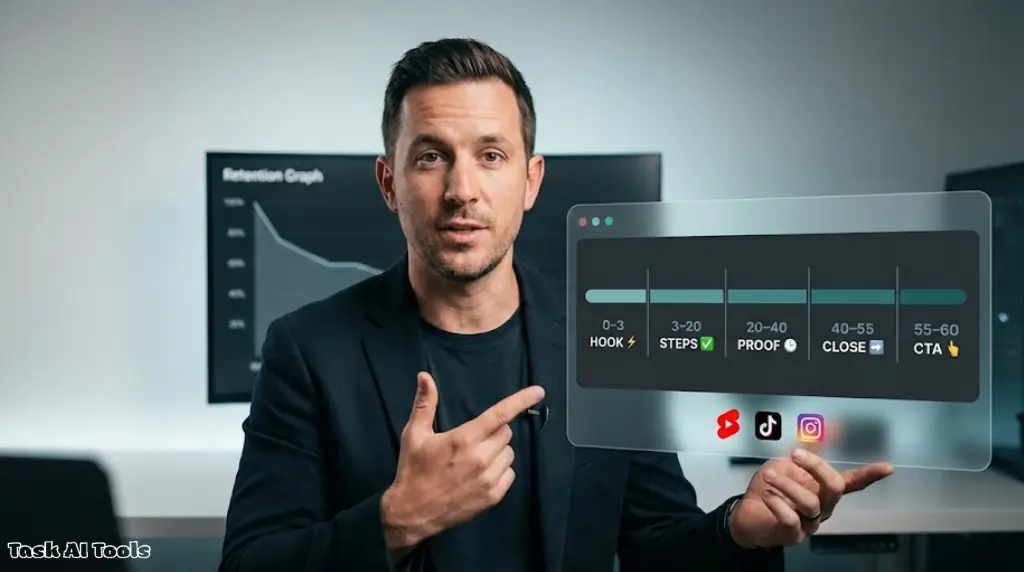
This short video script template helps you land a sharp hook, deliver a single benefit, and close with a memorable CTA. You’ll get beat timing, on-screen text cues, and B-roll prompts tailored to quick formats. For tool setups, prompt tactics, and cross-platform reuse, consult our comprehensive AI script generator guide to standardize your workflow and scale output.
What a 30–60s script must do
- Win the first three seconds with a sharp promise
- Show one concrete outcome with a quick proof
- Ask for one action with zero friction
Keep only one idea. If you feel the urge to add a second benefit, save it for the next version.
The timing template
0–3s Hook
Say the win in plain words. Use action plus result.
- you waste time writing drafts. try this 3 line outline
- i doubled watch time with one change
- stop opening cold videos with your name. open with the payoff
3–20s Value beat 1
Show how to reach the win. One step. One example.
- show the outline on screen
- walk through line one
- add a quick before and after clip
20–40s Value beat 2
Give a second step or micro proof. Keep it visual.
- show a timer to prove speed
- display a comparison frame
- add a line of social proof or metric
40–55s Close
Wrap the idea and bridge to action.
- repeat the win in eight words or less
- point to the next step the viewer already wants
55–60s CTA
Ask for one simple action
- grab the template in the description
- watch the full breakdown on the channel
- save this to build your next video
Hook lines you can steal
- spend less time on drafts and more on delivery
- three lines to plan a clean script in one minute
- one small edit that boosts retention on short video
- the first sentence that stops the scroll
If a hook feels loud, drop the hype and keep the promise. Calm beats noise on many accounts.
On screen text and captions
Use large text for the hook. Seven words max. Keep captions clean and high on the frame so they do not fight with lower third graphics. Highlight verbs not adjectives. Example
- hook text: cut script time by half
- beat text: step 1 plan three lines
- close text: save for your next draft
B roll and shot list
Plan two or three shots. That is enough for pace and variety.
- a roll face to camera for the hook and close
- b roll screen capture for the steps
- cutaway hands on keyboard or a notepad for rhythm
Mark each shot in your script. Your edit will move faster when you can scan for visuals.
Voiceover and pacing
Speak like you would teach a friend. Short sentences. Natural pause every eight to ten words. Leave a beat of silence before the hook ends and before the CTA starts. That pause gives the viewer a breath and lifts retention.
The reusable script sheet
Copy this and fill the blanks for each project.
Hook
[win in one line]
because [pain in a few words]
Step 1
say [action]
show [quick visual]
proof [micro metric or before after]
Step 2
say [action]
show [quick visual]
proof [micro metric or quote]
Close
repeat [win]
bridge [why this matters now]
CTA
ask [one clear action]
Keep it in a note app or as a one page doc. Track which hooks plus steps hold the most watch time. Small changes add up.
Platform tweaks
- YouTube Shorts Lead with the hook on word one. Avoid long music intros. Leave an extra second at the end so the end card does not cut the CTA.
- Instagram Reels Use bigger on screen text. Add one beat where you point at the caption area if the next step sits there.
- TikTok Open with a bold claim then prove it fast. More jump cuts. Tighter captions.
Quality checks before publish
- the hook makes a promise and uses plain words
- each beat shows one step not three
- the CTA is a single action
- audio is clear and music does not cover the voice
- framing leaves space for captions and UI
Common mistakes
- stacking two benefits in one short
- long intros with your name or backstory
- heavy jargon that slows the ear
- too many cuts that feel nervous
Why this works for freelancers
Clients hire speed and clarity. A standard template lets you draft in minutes and edit in less time. You can pitch angles with sample scripts before you ever hit record. That builds trust and keeps projects moving. Over time you grow a bank of hooks and steps that fit different niches. The process becomes repeatable which means less stress and more margin.
You now have a simple 30–60s script you can use on your next project. If you need a longer structure that explains a product with clean logic and proof, read the explainer video script template for a step by step flow you can adapt to any niche.
