
Zapier vs n8n for AI automation: Which should you choose in 2026?
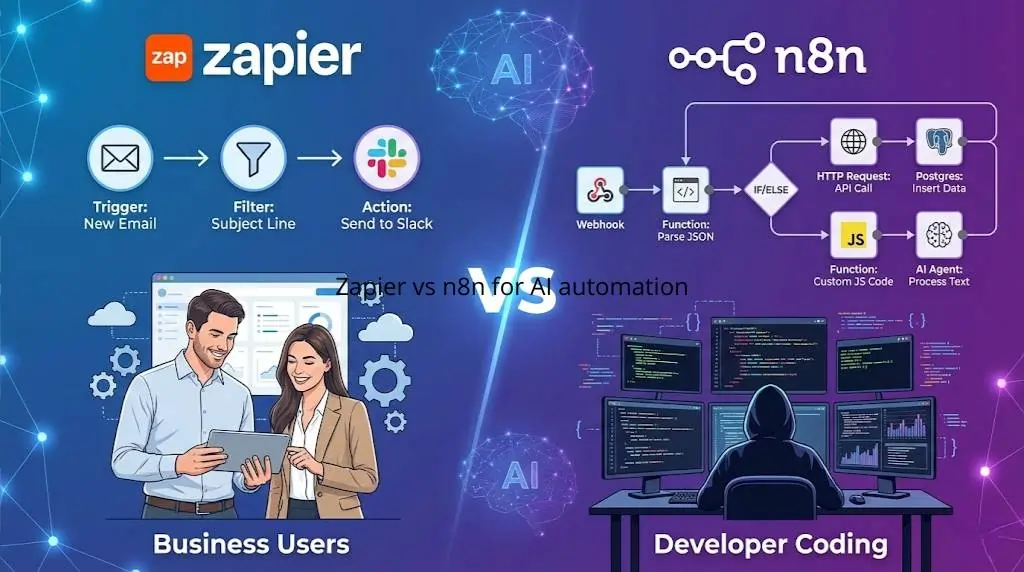
The ultimate 2026 battle: Zapier vs n8n for AI automation. Compare features, pricing, and AI integrations to scale your freelance business with smart workflows.
Choosing the right platform is critical as we enter 2026 because the gap between simple task triggers and sophisticated agentic workflows has widened. In this Zapier vs n8n for AI automation comparison I look at how each tool handles the latest large language models and autonomous agents that freelancers now rely on for daily production. While Zapier offers unmatched simplicity with over 7000 integrations n8n has become the favorite for those needing deep technical control and data privacy.
As of January 2026 Zapier has stabilized its professional tier at 29.99 USD per month including its new central AI actions hub. Meanwhile n8n continues to disrupt the market with its 20 USD starter plan that allows for self-hosting and unlimited node execution. This guide breaks down which ecosystem will actually save you more time and money based on your specific freelance niche and technical comfort level.
How does n8n vs Zapier pricing for freelancers compare in 2026?
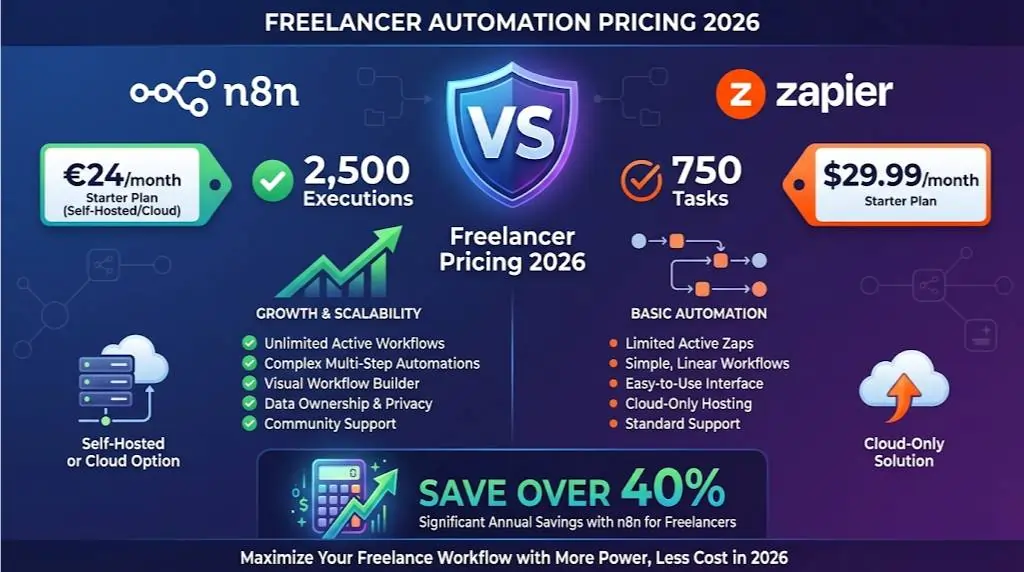
As a freelancer your tech stack is often your biggest overhead after taxes. In early 2026 the gap between “paying for convenience” and “paying for performance” has never been wider. If you are still running on old automation habits you might be losing hundreds of dollars every month to task-based billing models that no longer make sense for modern workflows.
When we look at n8n vs Zapier pricing for freelancers the decision usually comes down to how much data you move. Zapier remains the king of “set it and forget it” for simple tasks but their price per task has climbed significantly as they focus on enterprise features. Meanwhile n8n has solidified its position as the go-to for freelancers who want to scale without a linear increase in their monthly subscription.
The Real Cost of Scaling: Zapier vs n8n for AI Automation
The game changed when AI became the core of our workflows. In 2026 Zapier vs n8n for AI automation is the most critical comparison you can make because AI steps are expensive. A single AI-driven workflow might involve five or six different “tasks” or “steps” just to process one lead. On Zapier this can eat through a starter plan in a matter of days.
n8n handles this differently. Because they offer a self-hosted option and a credit-based cloud model that favors execution volume n8n allows you to run complex AI loops—like summarizing 100 emails or generating daily LinkedIn content—without hitting a massive paywall. If your business relies on LLMs to do the heavy lifting n8n generally offers a 40% to 60% better ROI on your monthly spend.
2026 Pricing Comparison: Monthly Budget Breakdown
To give you a clear picture of your potential monthly investment I have broken down the current January 2026 rates for both platforms based on typical freelancer usage levels.
| Feature / Tier | Zapier (Starter/Pro) | n8n (Cloud/Self-Hosted) |
|---|---|---|
| Starting Price | $29.99 / mo (billed monthly) | $20.00 / mo (Cloud Starter) |
| Task/Execution Limit | 750 Tasks | Unlimited Executions (on Self-Host) |
| AI Features | Premium Add-on Costs | Included in Core Nodes |
| Update Intervals | 1-15 Minutes | Instant / Real-time |
Choosing the Right Path for Your Bottom Line
If you are just starting out and only need to connect a Google Form to a Mailchimp list Zapier is still a solid choice. It is fast and requires zero server knowledge. However as you grow you will find that the ease of use comparison shifts once you factor in the stress of “task counting” every month.
For freelancers building serious AI agents or handling high-volume data processing n8n is the clear winner in 2026. By choosing n8n you are essentially decoupling your growth from your software costs. You can run 10,000 executions for nearly the same price as 1,000 which gives you the freedom to experiment with new AI services without checking your bank balance every morning.
What is the easiest AI automation platform for freelancers without coding skills?
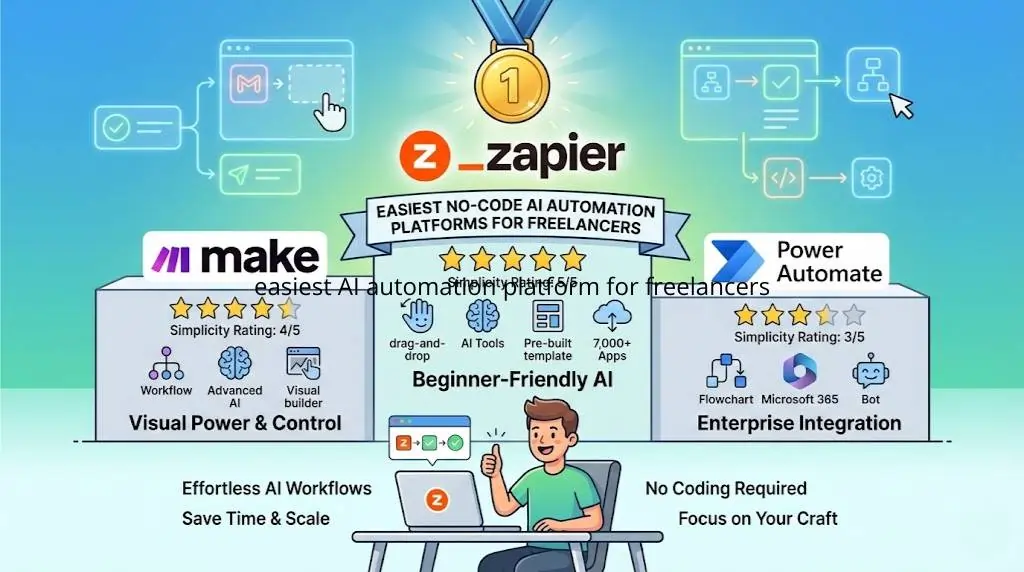
As a freelancer in 2026, you don’t have time to act as your own IT department. You need tools that work immediately so you can focus on billable hours. When searching for the easiest AI automation platform for freelancers, the conversation usually starts and ends with how much technical friction you are willing to tolerate. In the current landscape, “easy” no longer just means a pretty interface; it means how quickly an AI agent can build a workflow for you without you touching a single line of code.
For most solo operators, the goal is to connect a lead magnet to a CRM or have an AI summarize client meetings automatically. You want a platform that feels like an extension of your brain, not a puzzle you have to solve on your weekend.
Zapier’s Natural Language Supremacy
Zapier remains the front-runner for pure ease of use because of its “Central” AI feature. In early 2026, Zapier updated its interface to be almost entirely conversational. You tell the bot what you want to happen, and it maps out the triggers and actions. For a freelancer who needs to set up a quick automation between Slack and Google Sheets, Zapier’s 7,000+ native integrations mean you almost never have to deal with Webhooks or API documentation.
It is the “set it and forget it” choice. However, that convenience comes with a trade-off in your monthly overhead. If you are scaling fast, you should look into the cost of automation to ensure your margins stay healthy as your task volume grows.
The Real Comparison: Zapier vs n8n for AI Automation
When we look at Zapier vs n8n for AI automation this year, the definition of “easy” shifts depending on your logic. Zapier is linear—it moves from point A to point B. n8n uses a visual canvas that looks like a mind map. For freelancers who handle complex data or multi-branching AI prompts, n8n’s visual flow is actually easier to troubleshoot because you can see exactly where a process stops.
In 2026, n8n introduced “LangChain Expressions” that allow non-coders to drag and drop AI nodes. While Zapier is easier to start, n8n is often easier to manage once your workflows get complicated. Here is how they stack up for a typical freelance setup:
| Feature (Jan 2026) | Zapier | n8n |
|---|---|---|
| Setup Speed | Instant (AI-generated) | Moderate (Template-based) |
| Learning Curve | Very Low | Low to Moderate |
| AI Capabilities | Built-in AI Agents | Deep LLM Orchestration |
| App Directory | 7,000+ Apps | 600+ (plus custom nodes) |
Why Visual Logic Wins for Creative Freelancers
Many freelancers are opting for n8n as the easiest AI automation platform for freelancers who work in design or content production. The reason is simple: visibility. When you are running an AI-driven content calendar, you need to see the branches of your logic. n8n’s 2026 “Canvas Debugger” allows you to click any node and see the AI’s thought process in real-time. Zapier is getting better at this, but it still hides a lot of the “magic” under the hood, which can be frustrating when an automation fails and you don’t know why.
Ultimately, if you want to type a sentence and have a workflow appear, Zapier is your winner. If you want to see a visual map of your business and have more control over your AI tokens, n8n is the smarter long-term move.
Is self-hosting AI workflows for freelancers worth the effort in 2026?
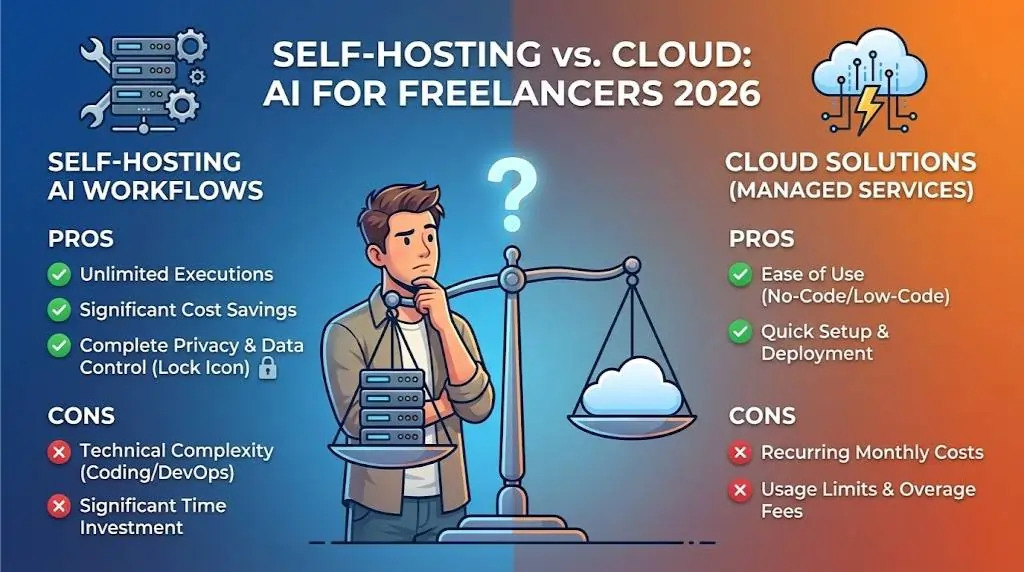
As we navigate the landscape of 2026 it is clear that data is a freelancer’s most valuable currency. While cloud platforms offer convenience they often come with a “privacy tax” and unpredictable scaling costs. Moving toward self-hosting AI workflows for freelancers isn’t just about being tech-savvy anymore. It is about building a moat around your business operations and ensuring your proprietary AI prompts and client data stay under your direct supervision.
When you self-host you are essentially running your automation engine on your own hardware or a private virtual server. This eliminates the middleman. For a freelancer handling sensitive client strategy or legal documents this shift provides a level of security that off-the-shelf cloud tools struggle to guarantee in the current regulatory environment.
Data Sovereignty and Cost Efficiency in 2026
The primary driver for self-hosting this year is the massive reduction in API overhead. By hosting your own instance of an automation tool you can connect directly to local LLMs (Large Language Models) running on your own machine. This bypasses the per-task fees that eat into your margins. Furthermore you gain total data sovereignty. You no longer have to worry about your automation provider using your unique workflow logic to train their own internal models.
Zapier vs n8n for AI Automation: The Self-Hosting Reality
When looking at Zapier vs n8n for AI automation the distinction becomes crystal clear. Zapier is a “walled garden” cloud service. You cannot self-host it. You are tied to their infrastructure and their pricing tiers. In contrast n8n was built with a fair-code philosophy that encourages self-hosting.
In 2026 n8n has optimized its Docker deployments making it possible for a freelancer with zero DevOps experience to spin up a private instance in under ten minutes. This allows you to run unlimited complex workflows without hitting the “task wall” that often stops Zapier users mid-project. If you are curious about how the numbers shake out for your specific volume check out this guide on Automation pricing to see the long-term savings.
| Feature (Jan 2026) | Zapier (Cloud) | n8n (Self-Hosted) |
|---|---|---|
| Data Privacy | Third-party managed | 100% User-controlled |
| Local AI Integration | Limited/Via API only | Native via Local LLMs |
| Monthly Base Cost | Subscription based | Free (Software) + Server cost |
| Execution Limits | Strict task quotas | Unlimited (Hardware limited) |
Technical Requirements for Modern Freelancers
You might think self-hosting requires a server room in your basement. In 2026 that is simply not the case. Most freelancers are using lightweight VPS providers or even dedicated “plug-and-play” home servers. To run a robust AI-driven workflow you generally need:
- A VPS with at least 4GB RAM: This handles the orchestration of multiple AI agents.
Docker Desktop:
- SSL Certification: Easily automated via tools like Let’s Encrypt to keep your workflow dashboard secure.
By taking this route you transition from being a renter of your business logic to being the owner. It requires a slightly steeper learning curve initially but the payoff in privacy and profit margins makes it the superior choice for any serious freelancer this year.
How to build AI lead generation workflows with Zapier and n8n?
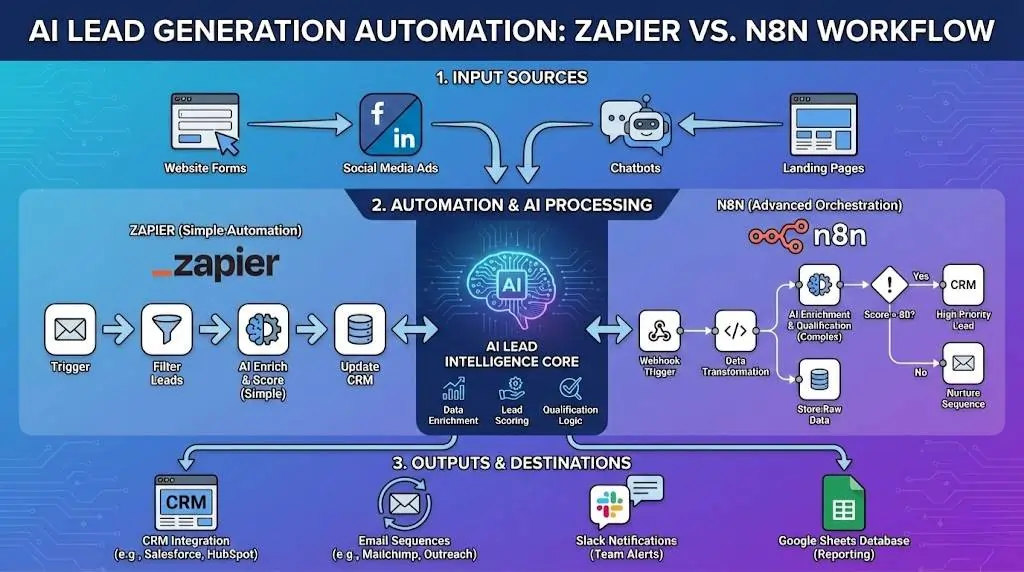
In 2026, manual prospecting is a relic of the past. As a freelancer, your time is your most valuable asset. If you are still spending hours scrolling through LinkedIn or manually emailing prospects, you are losing money. By building automated systems, you can ensure your pipeline stays full while you focus on billable client work. The real magic happens when you combine large language models with automation tools to identify, score, and reach out to high-value leads without lifting a finger.
Building an Automated Prospecting Engine
A modern lead generation workflow usually starts with a trigger—like a new follower on social media or a specific company hiring on a job board. Using AI, you can now analyze these leads in real-time. For example, you can scrape a prospect’s website, send that data to an LLM to summarize their current pain points, and then automatically draft a hyper-personalized pitch. By connecting LLMs to your workflow, you move beyond generic templates to messages that actually get replies.
Zapier vs n8n for AI Automation in Sales
When deciding which platform to use for your sales engine, the choice usually comes down to how much logic you need. Zapier is excellent for simple, linear lead captures—like sending a Facebook Lead Ad directly to your CRM with a quick AI summary. However, n8n excels when you need complex, multi-step branching. For instance, if you want to check a lead’s budget, verify their LinkedIn profile, and then choose between three different email sequences based on their industry, n8n’s node-based interface is superior.
As of January 2026, here is how the two platforms stack up for lead generation tasks:
| Feature | Zapier (2026) | n8n (2026) |
|---|---|---|
| Setup Speed | Instant (AI-generated Zaps) | Moderate (Manual Node Mapping) |
| Data Enrichment | Built-in Apps (Clearbit, etc.) | Heavy Web Scraping Capabilities |
| AI Native Tools | Centralized AI Actions | Advanced LangChain Integrations |
| Cost per Lead | Higher (Task-based pricing) | Lower (Self-hosted or Fixed Cloud) |
Lead Scoring and Automated Outreach
Not every lead is worth your time. In 2026, freelancers are using AI lead generation workflows with Zapier and n8n to implement “Lead Scoring.” This involves sending lead data to an AI agent that assigns a value from 1 to 100 based on your ideal customer profile. If a lead scores above 80, the automation triggers an immediate personalized email via Instantly or Woodpecker. If it scores lower, it simply adds them to a long-term nurture newsletter. This ensures you only jump on discovery calls with prospects who can actually afford your rates.
Ultimately, Zapier is your best bet if you want to set up a lead capture form in five minutes. If you are building a sophisticated “outreach machine” that scrapes data and uses custom AI agents to handle initial objections, n8n offers the technical depth you need to scale your freelance operations effectively.
How does LLM integration in Zapier vs n8n compare for advanced AI apps?
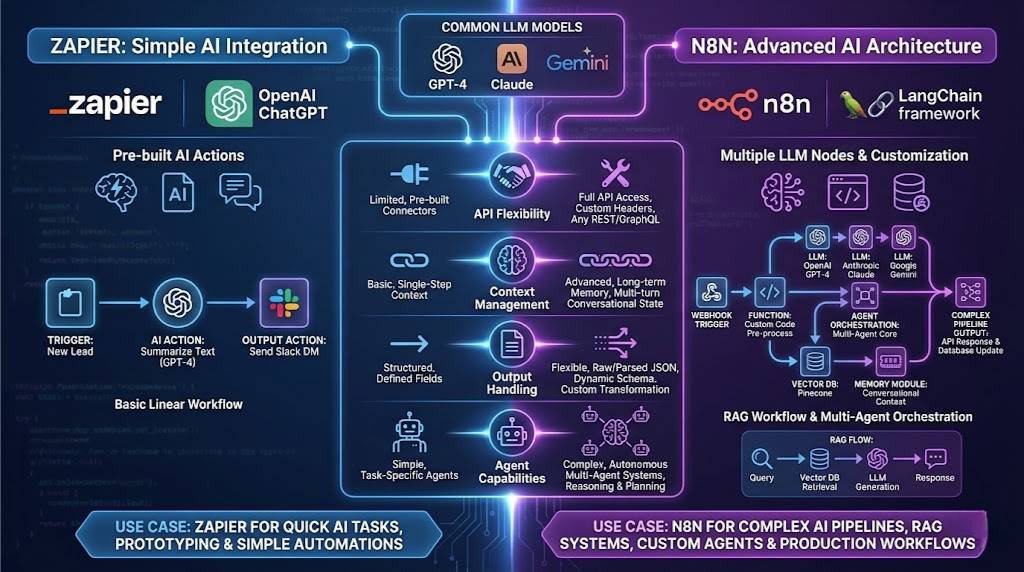
As we move into 2026, the gap between basic automation and “intelligent” systems has widened. For freelancers, the choice isn’t just about moving data from point A to point B anymore. It is about how you bake intelligence into those workflows. When we look at LLM integration in Zapier vs n8n, we are really looking at two different philosophies of control. One is built for speed and simplicity, while the other is built for architects who want to own the logic.
The Zapier Central AI Experience: Speed Over Granularity
Zapier has doubled down on its “Central” ecosystem in 2026. For a freelancer who needs to ship a solution in ten minutes, Zapier is tough to beat. Their LLM integration is largely handled through pre-built “AI Actions” and their Central bots which can remember context across different threads. However, the trade-off is the “black box” effect. You get less control over specific parameters like temperature or frequency penalties, and you are often locked into the versions of OpenAI or Anthropic that Zapier has prioritized that month.
Advanced Prompt Engineering: Zapier vs n8n for AI Automation
When you compare Zapier vs n8n for AI automation at a technical level, n8n is the clear winner for prompt engineering. In n8n, the AI nodes allow you to toggle every specific LLM parameter. More importantly, n8n treats “Memory” as a pluggable component. You can choose between Buffer Memory, Window Memory, or even connect a Vector Database like Pinecone directly to your workflow. This is vital for Lead gen automation where you need the bot to remember a prospect’s specific pain points over a three-week email sequence.
In n8n, you can also build “Chains” and “Agents” that use tools autonomously. While Zapier has similar features, n8n allows you to see the execution trace of every single step. If an LLM hallucination ruins a workflow, n8n lets you debug the exact prompt that caused the failure. In Zapier, you’re often left guessing why the output went sideways.
2026 Comparison: LLM Capabilities and Model Selection
The following table breaks down how these platforms handle the heavy lifting of AI integration as of January 2026.
| Feature | Zapier (Central/AI Actions) | n8n (LangChain/AI Nodes) |
|---|---|---|
| Model Selection | Curated (OpenAI, Claude, Perplexity) | Open (Any API, Local LLMs via Ollama) |
| Prompt Control | Basic System/User Prompts | Full Parameter Control (Temp, Top-P, etc.) |
| Memory Management | Managed by Zapier (Automatic) | Customizable (Motorhead, Redis, Buffer) |
| Vector Store Support | Limited/Managed | Native (Pinecone, Weaviate, Milvus, Supabase) |
| Cost per Execution | High (Task-based + AI Upcharges) | Low (Self-hosted or predictable Cloud tiers) |
Which Should a Freelancer Choose?
If you are building simple wrappers—like a bot that summarizes emails—Zapier is your best friend. It’s fast and the UI is friendly for your clients to manage later. But if you are positioning yourself as a high-ticket AI Consultant, n8n is the professional’s choice. Its ability to integrate with local LLMs via Ollama means you can offer clients “Private AI” solutions where data never leaves their server—a massive selling point in 2026’s privacy-conscious market. For sophisticated LLM integration in Zapier vs n8n, n8n provides the “pro” toolkit that justifies higher freelance rates.
Choosing between Zapier and n8n for your AI strategy in 2026 comes down to how much control you want over your data flow and your budget. Zapier remains the undisputed king of accessibility, offering a refined “no-code” environment that allows teams to deploy AI agents in minutes. However, as your automation volume scales, Zapier’s task-based pricing can become a significant overhead. If you need a platform that handles complex, multi-step AI reasoning without the premium price tag, n8n offers the technical depth and self-hosting options that power-users crave.
The decision often hinges on your technical comfort level and how deeply you plan to integrate LLMs into your core business processes. While Zapier excels at connecting disparate SaaS apps with zero friction, n8n provides a superior canvas for those who want to build sophisticated, branch-heavy AI workflows. For a deeper dive into how these platforms stack up for solo operators, check out our Ease of use comparison to see which interface aligns with your current skillset.
Ultimately, both platforms have evolved into robust AI orchestrators. Start with a small pilot project on both to see which logic feels more intuitive for your team. Build your first AI automation today.
